Every game in the cove rewards what you notice, not what you hope for. These are the habits our strongest players share, and how to grow them a few minutes at a time.
Look one move further than you think you need to
The habit we see most in good players is simple: they look ahead. In Raft-Up Merge they picture where the next sea star could land before they push. In Pontoon Drop they read the next queue as closely as the falling shape. In Glass Float Pop they check the waiting piece before taking the current shot.
None of this has to be slow. A glance is enough once it becomes a habit. Start by forcing yourself to name the next move out loud, quietly, before making the current one. Within a week you will be doing it without thinking, and your boards will feel calmer and last noticeably longer.
Even Dockline Dash rewards looking ahead. Players who watch the planks a little further in front of the runner jump earlier and more smoothly than those who stare at their own feet. Shift your eyes slightly to the right of the action and the next obstacle stops being a surprise. In every corner of the cove, the future is where the score is decided, and a habit of looking for it costs nothing to build.
Build a shape before you chase a score
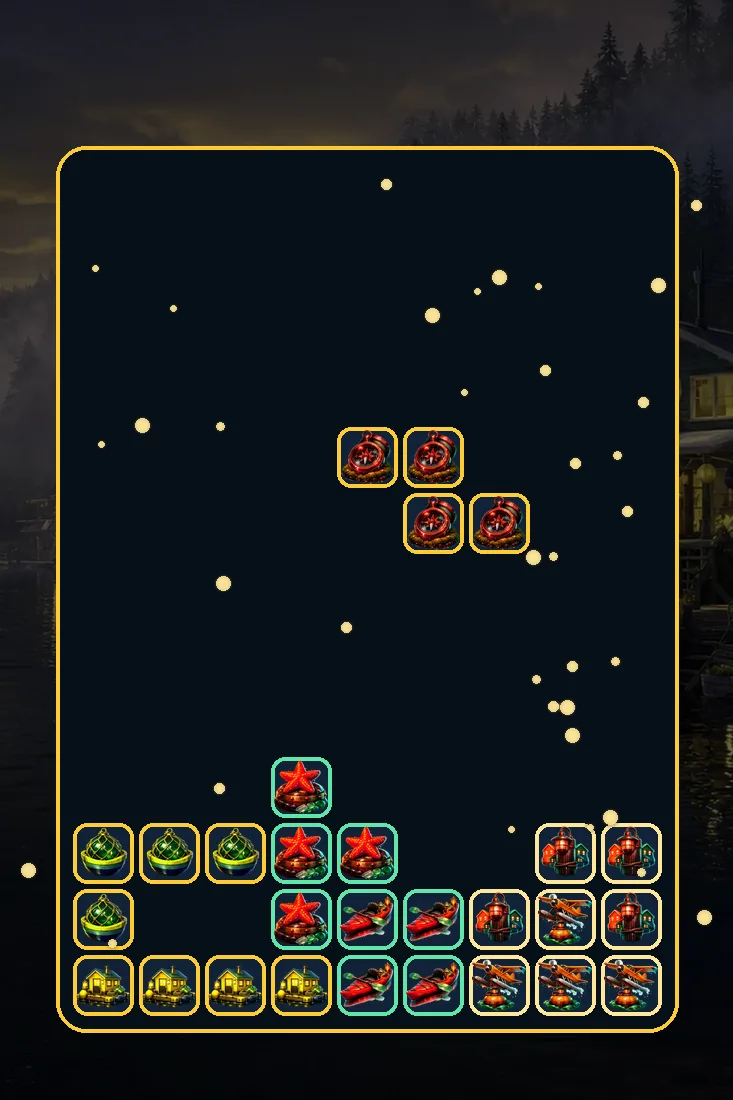
Several of our games reward structure more than quick wins. In Raft-Up Merge the structure is a corner: one home port for your biggest piece, with the ladder growing out from it. In Pontoon Drop it is a flat stack with one open column along a wall, waiting for the long piece to clear several lines at once.
Glass Float Pop has its own version. Rather than popping whatever matches, look for the anchors that hold up big clusters and plan shots that free them. One well-chosen pop can drop a third of the board, which beats five scattered small matches every time. Structure is just a way of making later moves easier now.
Chart Room Grids is all structure, really. Strong solvers do not wander the grid; they work the biggest clues first, then the lines that a fresh cross has changed, then the next biggest. Fogbank Words rewards a system too: longest word first, or a row-by-row sweep for each first letter. A tidy method beats frantic darting in every game we make.
Treat empty space as information
Beginners look at what is on the board. Experienced players look at what is missing. In Chart Room Grids the crosses you place are as useful as the filled squares, because they tell you where a run cannot go. Many tricky lines only open up once you have crossed off enough empty squares.
Pontoon Drop works the same way. The holes in your stack matter more than the blocks, because a single buried gap can hold back an entire row. Train yourself to scan for gaps after every drop. In Raft-Up Merge, an empty square next to your corner is a risk, since a fresh piece can land there and break your chain.
Even word searches reward it. Once a few capsules are in place, the letters they cover are less likely to hold the remaining words, so your eyes can focus on the uncovered patches. Across all six games, learning to see the empty parts of the board is the quickest way to stop feeling overwhelmed by the full ones.
Know when to reach and when to hold back
A few games tempt you with extra points that carry risk. Sea stars in Dockline Dash are worth ten points but sometimes need an awkward high leap. A clever bank shot in Glass Float Pop can drop a cluster, or miss and leave a stray piece in a bad spot. Judging the moment is the skill.
Our rule of thumb: reach while things are calm, protect what you have when they are busy. Early in a run, grab every sea star. Later, with the boardwalk racing, bank the metres. In Glass Float Pop, try ambitious angles while the ceiling is high and switch to safe, low clearing as it closes in.
Raft-Up Merge has a quieter version of the same choice. A merge that scores now might drag a piece out of your corner and weaken the board for later. Strong players regularly turn down a tempting merge to keep their structure intact. Learning to say no to an attractive move is a skill that carries across the whole cove. It feels odd at first and then, quite suddenly, it feels obvious.
Use your bests like a tide table
Every game keeps your personal best, and that number is a very good guide when used gently. Instead of aiming for a huge leap, try to edge it up a little: a few more metres on the boardwalk, one more tier lit on the ladder, a slightly quicker clear of your favourite word pack.
Small improvements pile up surprisingly quickly, and they keep the games feeling fresh. Come back after a week away and you will often find your hands remember more than you expected. Our own studio bests crept upward mostly over long Canadian winter evenings, a few minutes at a time, rather than in any single heroic session.
Stars are a second, friendlier guide. Dockline Dash, Fogbank Words and the other games award them for how well a round went, and going back for a missing one makes a tidy little project. Pick one game a week to focus on, play the others just for fun, and watch the habits from one spill into the rest. Looking ahead, building structure and reading empty space are the same skill everywhere, which is the nicest secret in the cove.