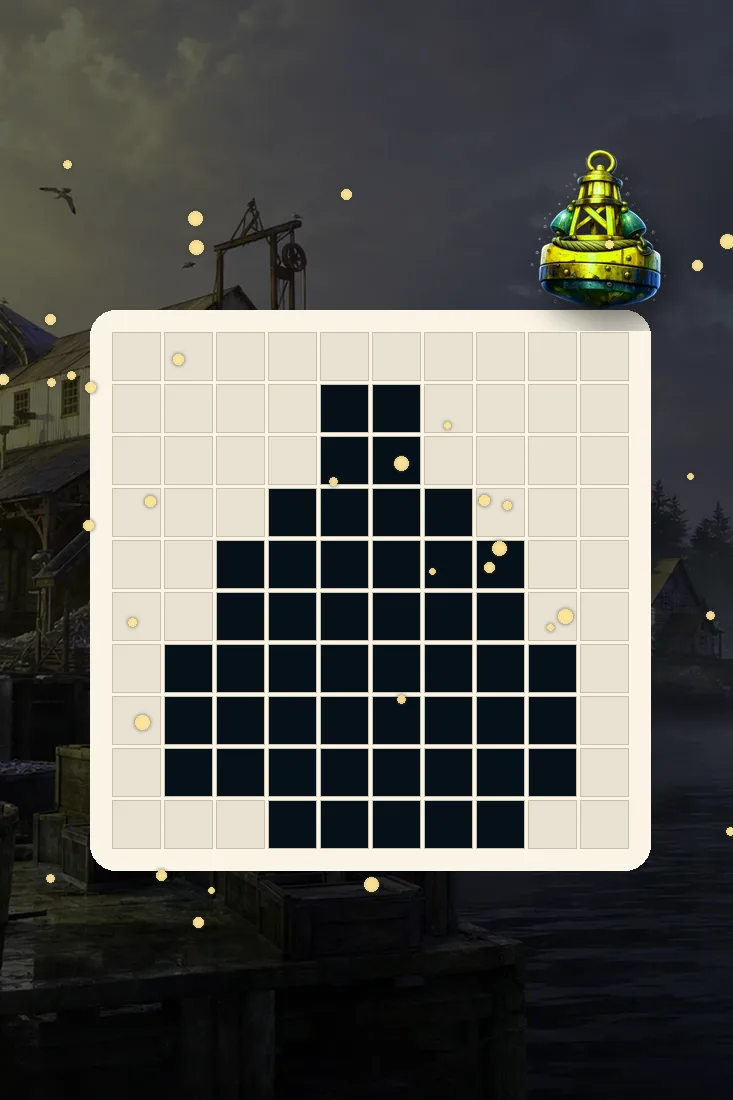
Chart Room Grids is our take on the picture logic puzzle, sometimes called a nonogram. Every grid hides one of twelve cove motifs: a tufted puffin, the yellow floatplane, a silver propeller, a sea otter, a sea star, a sword fern, a kayak paddle, a red kayak, a float home, a channel marker, a dock beacon and a leather pilot cap. You never see the picture until you have earned it.
Along the edge of each row and column runs a short list of numbers. Each number is a run of filled squares in that line, in order, with at least one empty square between runs. Combine what the rows and columns tell you, fill the squares you are sure of, cross off the ones that must stay empty, and the shape slowly emerges.
How to play Chart Room Grids
- Choose a motif and a size of 10x10 or 15x15 on the start screen.
- Read the clue numbers beside each row and above each column of the grid.
- Fill squares you can prove must be filled; drag to paint a run of several at once.
- Switch to cross mode to mark squares that must stay empty, so you never second-guess them.
- Satisfy every clue and the finished grid reveals the motif in its full colours.
Chart Room Grids controls
Getting better at Chart Room Grids
- Start with the biggest numbers. A run of eight in a ten-square row always fills the middle six.
- Cross off empty squares as eagerly as you fill; crosses are information, too.
- When a row is finished, cross the rest of it at once so it stops cluttering your view.
- Lit-up clues help you see which numbers a line still needs; use them to choose your next row.
- Try each motif at 10x10 first; knowing the outline makes the larger grid far friendlier.
Every puzzle drawn from the cove’s own pictures
We did not design these grids square by square. Each one is built from the outline of a cove icon, sampled down to a 10x10 or 15x15 grid, so the solution is the real silhouette of a puffin in flight or a floatplane on its pontoons. We picked twelve icons with strong, clear shapes so the pictures read well even at the smaller size.
That gives the reveal a little extra charm. You spend the puzzle staring at grey squares and crosses, half guessing what the shape might be, and then the full-colour icon fades in over your work. Recognizing the propeller blade or the curl of the fern a few rows before the end is a lovely moment of its own.
Two sizes, and how the larger grid changes the work
The 10x10 grid is the place to learn. Clues are short, lines are easy to read, and most rows give something away on the first pass. It is a good warm-up after dinner, and a fine grid to work through with a child, one clue at a time.
The 15x15 grid asks for more patience. Long rows hold several runs, and the early fills often come only from overlaps between the biggest numbers. You will cross off more squares, revisit lines more often and lean on the column clues to break deadlocks. It rewards careful reasoning rather than speed, which is why it is our favourite on a wet afternoon.
Questions about Chart Room Grids
Each number is a run of filled squares in that row or column, listed in order. Different runs are always separated by at least one empty square.
The grids are built so that careful reasoning from the clues gets you there. If you feel stuck, look for a line where the biggest number overlaps itself, or a line that a nearby cross has just changed.
Twelve motifs, each playable at 10x10 and at 15x15. The larger version of a motif shows more detail, so solving it feels quite different from the small one.